
6.1 KiB
Draw the model. Click run. Read the diagrams.



Pre-alpha. Under active development. APIs and file formats will change.
 |
 |
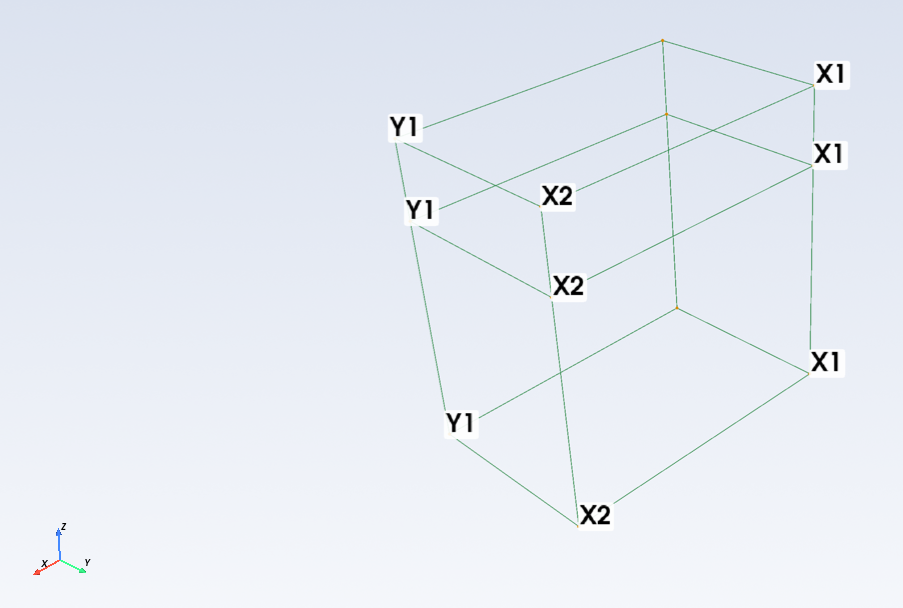 |
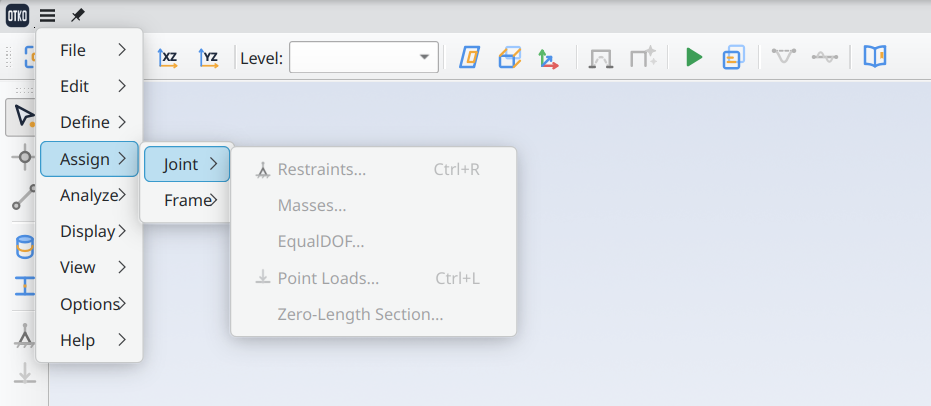
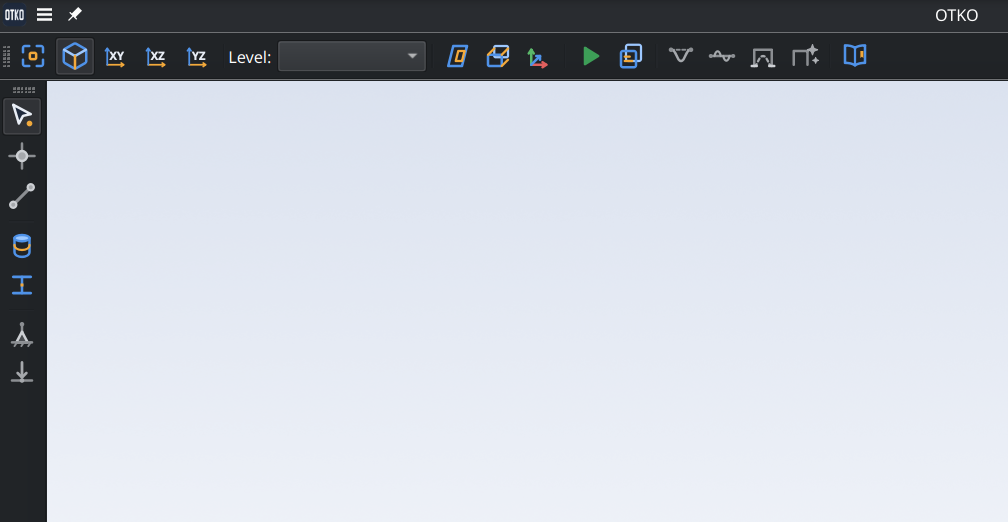
| SAP2000-style menus | Compact dark toolbar | Parametric grid wizard |
What is OTKO?
OpenSees does nonlinear FEM well. Its user interface is a script. OTKO puts a visual front-end on top of it: draw nodes, frames, supports, and loads on a snapped grid; assign materials, sections, and load patterns through dialogs; run the analysis with progress and cancel; then read the results — deformed shapes, mode shapes, force diagrams, pushover curves, hysteresis loops.
Underneath, the core Pydantic model works fine from a script or
notebook without any GUI. The GUI is a front-end, not the whole
product.
Highlights
| Area | What you get |
|---|---|
| Modeling | Grid wizards, nodes, frames (elastic + force-based), trusses, quads, zero-length sections, restraints, equalDOF constraints, distributed loads, ground motions (PathTimeSeries / UniformExcitation). |
| Materials & sections | Steel01, Steel02, Concrete01, Concrete02, ElasticPP, Hysteretic, fiber sections (rectangular / circular patches + rebar), SectionAggregator, BeamWithHinges. |
| Analysis | Static (load- or displacement-controlled), modal, pushover, transient time-history with mode-1 Rayleigh damping. Chained workflows: gravity preload → loadConst -time 0.0 → pushover or transient. |
| Post-processing | Deformed shape with scale slider, animated mode shapes, axial / shear / moment diagrams, pushover curves, time-history plots, hysteresis loops, response-spectrum SRSS / CQC, snapshot + video export. |
| Persistence | One Pydantic-validated .osmodel JSON per project — diffs cleanly in Git, builds cleanly from Python. Analysis output in HDF5 (*.osresults.h5). |
20+ verified examples ship with the repo, including OpenSees Wiki
Examples 1–4 and a fiber-section RC frame pushover. See
examples/README.md.
Quick start
git clone ssh://git@smill-home.ddns.net/smill/otko.git
cd otko

python -m venv .venv
.venv\Scripts\activate              # Windows
source .venv/bin/activate           # Linux / macOS

pip install -e ".[gui,dev]"         # desktop: Qt + PyVista + dev tools
# pip install -e .                  # headless: core + services only

python -m otko
Then:
- File → Open →
examples/cantilever.osmodel. - Analyze → Cases → run
Tip-Load. - Display → Show Force Diagram → M3: 50 kN·m at the fixed end. V2: constant −10 kN.
- Display → Show Deformed Shape → the cantilever curve.
Nonlinear version: open examples/portal_pushover.osmodel, run
Push-X, Display → Show Pushover Curve — elastic ramp, then a
yield plateau as the base hinges form.
Python 3.10+. On Windows use 3.12+ — openseespywin==3.8.0.0
has no 3.11 wheel (Requires-Python >=3.12). Both pins already
live in pyproject.toml.
Architecture
Strict MVVM + service layer, one direction only:
views (Qt) → viewmodels → services (OpenSeesRunner, Persistence) → core (model)
core is pure Python — no Qt, no OpenSeesPy imports — and unit-tests
in isolation. PySide6 + PyVista on the view, pyqtgraph for 2D plots,
Pydantic v2 for the model, h5py for results. Long version, including
the OpenSeesPy command order the runner emits, in
docs/architecture.md.
Roadmap
docs/roadmap.md has the phase-by-phase plan.
Phases 0–7 (modeling, analysis, post-processing) are mostly done.
Phase 8 — isolators, ground-motion library, IDA, fiber-section
editor polish — is where the open work is.
Contributing
Collaborators welcome — most useful to people who already work with OpenSees and want a shorter path from idea to model:
- Structural / earthquake engineers who can tell us when a feature is almost right but not quite.
- Researchers running pushover, IDA, or response-spectrum studies against hand-built scripts.
- Python / Qt developers into scientific desktop apps, VTK rendering, or Pydantic schema design.
- Students learning FEM and GUI architecture — the examples and tests are meant to read as documentation.
- UX / icon designers willing to argue about dialogs and toolbars.
Bug reports and reproducible test cases count as contributions. Setup
and the rules enforced in review: CONTRIBUTING.md.
Test suite:
pytest tests/unit          # pure logic, milliseconds
pytest tests/gui           # Qt event-loop tests (pytest-qt)
pytest tests/integration   # real OpenSeesPy runs on bundled examples
CI runs lint + the non-slow subset on Linux / macOS / Windows
× Python 3.10 / 3.11 / 3.12.
License
OTKO is GNU Affero General Public License v3.0
(LICENSE). In short:
- Research, education, personal projects: fine, keep the copyright notice.
- Fork and modify: fine.
- Distribute it (modified or not): release your full source under AGPL-3.0.
- Run a modified version as a network service: release your modifications under AGPL-3.0.
Commercial forks stay open. If you need a different arrangement (e.g. a closed-source commercial license), open an issue.
Copyright © 2026 Ozan and contributors.