 smillmorel
ba783718d4
smillmorel
ba783718d4
Catch-all for the intermixed residue of the unpushed otko-development
work ported into this tree: combinations/console-dock/quick-guide wiring
across commands, core, services, views and tests; repo-wide ruff-format
normalization; README/CONTRIBUTING updates; and the toolbar default
(both toolbars now open in the top area, quick guide text updated).

Splitting this further would require hunk-level surgery with low
confidence; the preceding commits in this branch isolate the
self-contained features.
6.7 KiB
A SAP2000-style desktop GUI for OpenSeesPy. Draw the model, click run, look at the diagrams.
Pre-alpha. Under active development. APIs and file formats will change.
Why
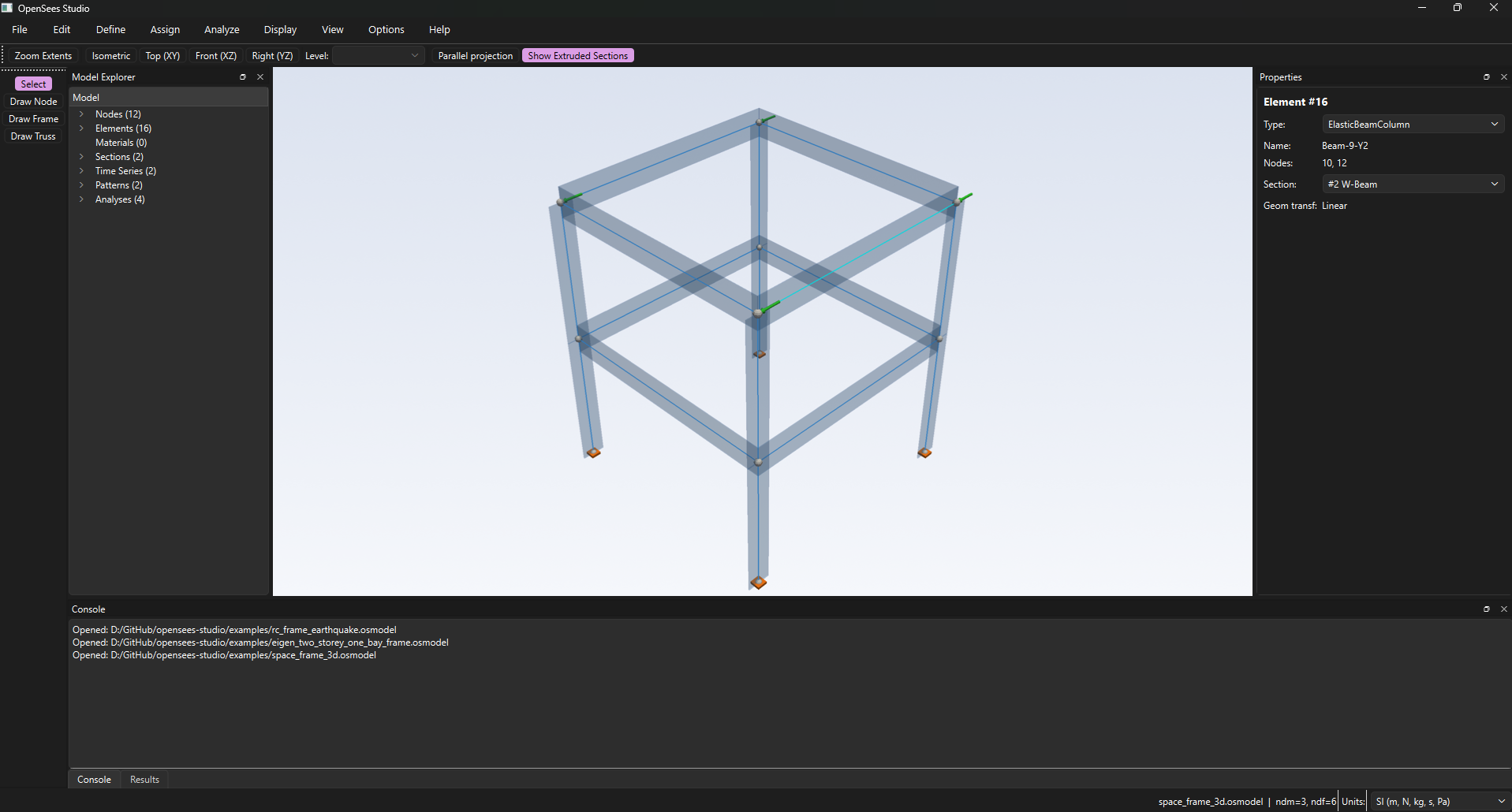
OpenSees does nonlinear FEM well. Its user interface is a script. OTKO puts a visual front-end on it:
- Draw nodes, frames, supports, and loads on a snapped grid.
- Assign materials, sections, and load patterns through dialogs.
- Run static, modal, pushover, and time-history analyses with progress and cancel.
- Look at the results — deformed shape, mode shapes, force diagrams, pushover curves, time-history plots, hysteresis loops.
- Save the model as one
.osmodelJSON file. Diffs cleanly in Git, builds cleanly from Python.
Underneath, the core Pydantic model works fine from a script or
notebook. The GUI is a front-end, not the whole product.
What works today
- Modeling — grids, nodes, frames (elastic + force-based), trusses,
quads, zero-length sections, restraints, equalDOF constraints,
distributed loads, ground motions (
PathTimeSeries/UniformExcitation). - Materials and sections —
Steel01,Steel02,Concrete01,Concrete02,ElasticPP,Hysteretic, fiber sections (rectangular / circular patches + rebar layers),SectionAggregator,BeamWithHinges. - Analyses — static (load- or displacement-controlled), modal,
displacement-controlled pushover, transient time-history with
mode-1 Rayleigh damping. Chained workflows: gravity preload →
loadConst -time 0.0→ pushover or transient. - Post-processing — deformed shape (with scale slider), animated mode shapes, axial / shear / moment diagrams, pushover curves (in display units), time-history plots, hysteresis loops, response-spectrum SRSS / CQC, snapshot + video export.
- Persistence — one JSON
.osmodelper project, Pydantic-validated, round-trips clean. - Examples — 20+ verified examples, including OpenSees
Wiki Examples 1–4 and a fiber-section RC frame pushover.
See
examples/README.md.
Tech stack
| Layer | Library |
|---|---|
| GUI | PySide6 (Qt 6) |
| 3D viewport | PyVista + pyvistaqt (VTK) |
| 2D plots | pyqtgraph |
| Solver | OpenSeesPy 3.8.0.0 |
| Numerics | NumPy |
| Storage | Pydantic v2 (model), h5py (results) |
| Tests | pytest, pytest-qt |
| Lint / type | ruff, mypy |
Architecture
Strict MVVM + service layer. core is pure Python — no Qt,
no OpenSeesPy imports — and unit-tests in isolation.
views (Qt) → viewmodels → services (OpenSeesRunner, Persistence) → core (model)
Long version in docs/architecture.md,
including the OpenSeesPy command order the runner emits.
Documentation
Practical, task-first walkthroughs live in
docs/QUICK_GUIDE.md — a cantilever build,
modal analysis, report/script export, display units, and undo/redo.
The full index is docs/README.md.
Install (development)
Desktop GUI (Qt, PyVista, pyqtgraph, imageio):
git clone ssh://git@smill-home.ddns.net/smill/otko.git
cd otko

python -m venv .venv
.venv\Scripts\activate              # Windows
source .venv/bin/activate           # Linux / macOS

pip install -e ".[gui,dev]"
Headless (core + services only, no Qt):
pip install -e .
That pulls pydantic, numpy, h5py, openseespy and nothing else.
Use it for scripts, notebooks, and web backends that reuse
otko.core or otko.services without the GUI.
Python 3.10+. On Windows use 3.12+ — openseespywin==3.8.0.0
has no 3.11 wheel (Requires-Python >=3.12). Both pins already
live in pyproject.toml.
Quick start
python -m otko
Then:
- File → Open →
examples/cantilever.osmodel. - Analyze → Cases → run
Tip-Load. - Display → Show Force Diagram → M3: linear moment, 50 kN·m at the fixed end. V2: constant -10 kN.
- Display → Show Deformed Shape → cantilever curve, as advertised.
Nonlinear version: open examples/portal_pushover.osmodel,
run Push-X, Display → Show Pushover Curve. Elastic ramp,
then a yield plateau as the base hinges form.
Run the test suite
pytest tests/unit          # pure logic, milliseconds
pytest tests/gui           # Qt event-loop tests (pytest-qt)
pytest tests/integration   # real OpenSeesPy runs on bundled examples
CI runs lint + the non-slow subset on Linux / macOS / Windows
× Python 3.10 / 3.11 / 3.12.
Roadmap
docs/roadmap.md has the phase-by-phase plan.
Phases 0–7 (modeling, analysis, post-processing) are mostly done.
Phase 8 (isolators, ground-motion library, IDA, fiber-section
editor polish) is where the open work is.
Collaborators wanted
Most useful to people who already work with OpenSees and want a shorter path from idea to model — and would rather build it together than alone. Open an issue or say hi if you are:
- A structural / earthquake engineer who knows OpenSees Tcl or OpenSeesPy and can tell us when a feature is almost right but not quite.
- A researcher running pushover, IDA, or response-spectrum studies who can check the GUI against hand-built scripts.
- A Python / Qt developer into scientific desktop apps, VTK rendering, or Pydantic schema design.
- A student learning FEM and GUI architecture at the same time — the examples and tests are meant to read as documentation.
- A UX / icon designer willing to argue about dialogs, toolbar icons, and visual language.
Bug reports and reproducible test cases count as contributions.
See CONTRIBUTING.md for setup and the rules
enforced in review.
License
OTKO is GNU Affero General Public License v3.0
(LICENSE). Read the license itself, not just this:
- Research, education, personal projects: fine, keep the copyright notice.
- Fork and modify: fine.
- Distribute it (modified or not): release your full source under AGPL-3.0.
- Run a modified version as a network service: release your modifications under AGPL-3.0.
Commercial forks stay open. If you need a different arrangement (e.g. closed-source commercial license), open an issue.
Copyright © 2026 Ozan and contributors.